
Have you thought about who needs a fire risk assessment in the UK? Yes, fire risk assessment requirements are a legal duty for many buildings in the UK. It helps find fire hazards, protect people, and keep property safe.
Here is a real example that shows why this matters. In 2020, Hillcroft Residential Care Home in South Wales failed to follow fire safety rules. Inspectors found blocked escape routes, missing alarms, and unsafe fire doors. The company had to pay a fine of £432,944.64 for not meeting fire risk assessment requirements. Thankfully, after proper action, the home improved its safety, and residents stayed protected.
In this blog, we explain who does a fire risk assessment, the different types, what UK law says, and simple steps to keep people and buildings safe.
Is a Fire Risk Assessment a Legal Requirement in the UK?
Yes, any business, organization, or building used by the public must carry out a fire risk assessment. The law requires identifying fire hazards, evaluating risks to people, and implementing measures to reduce danger.
What Does the Regulatory Reform Fire Safety Order 2005 Oblige Employers to Do?
The Regulatory Reform (Fire Safety) Order 2005 (RRO 2005) applies to England, Wales, and Scotland. On the other hand, in Northern Ireland, Fire and Rescue Services Order 2006 applies.
Key duties for the Responsible Person include: Conducting a suitable and sufficient Fire Risk Assessment. Identifying fire hazards such as electrical equipment, combustible materials, and ignition sources. Staff must be informed about fire risks and trained in fire safety procedures. For premises with five or more employees, the employer must record the significant findings of the fire risk assessment. Installing and maintaining fire detection and warning systems (alarms, smoke detectors). Maintaining means of escape (clear, marked exit routes, emergency lighting, staircases). Providing fire-fighting equipment (extinguishers, hose reels, sprinklers if needed). Ensuring emergency planning (evacuation plans, drills, staff training). Maintaining fire safety precautions (signage, safe storage of flammables, regular inspections). Reducing risk to employees, contractors, visitors, and residents. Installing and maintaining fire detection systems, fire-fighting equipment, and emergency routes. Providing fire safety training, instruction, and information. Keeping records of assessments, maintenance, and training.
How the Building Safety Act 2022 Changed Fire Risk Assessment Requirements?
The Building Safety Act 2022 applies in England. This law focuses on higher-risk buildings, such as residential buildings over 18 meters or six storeys.
Key points include: Clearly defined Accountable Person responsible for fire and structural safety. Requirement for safety case reports detailing building risks and mitigation measures. Increased inspection frequency, maintenance, and documentation. Stronger enforcement powers for the Building Safety Regulator, including fines and stop notices. Focus on building materials, cladding, and fire doors, particularly in high-rise residential buildings.
Fire Safety Regulations 2018 and Their Impact on Compliance
The Fire Safety Regulations 2018, applicable in the UK, complement RRO 2005 and focus on residential premises. Following these rules helps keep people safe and protects the building owner from legal problems.
Key elements include: Duties for multi-occupied residential buildings, including installation and maintenance of smoke alarms, fire doors, escape routes, and emergency lighting. Requirement for evacuation procedures and resident instruction. Ensuring regular fire risk reviews, inspections, and monitoring. Clear responsibilities for building owners, managing agents, and landlords.
When Is a Fire Risk Assessment Required for Your Property?
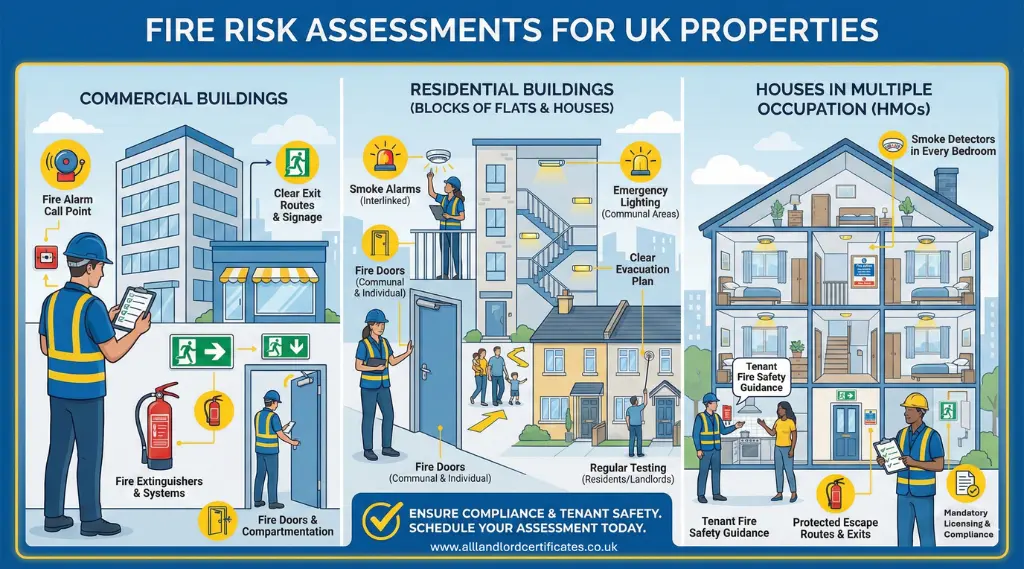
You need a fire risk assessment anytime you own or manage a property where people live, work, or visit. It is required for commercial buildings, houses with multiple tenants, and any property where fire safety can affect others. The assessment helps spot risks, protect people, and follow the law.
Commercial Property Fire Risk Assessment Requirements
If you own a commercial property, you need to follow the rules in the Regulatory Reform (Fire Safety) Order 2005 in England and Wales. If you’re not following the rules, you can get into trouble with fines or jail time.
The main things to do are: Appointing a responsible person, like the employer, owner, or occupier. Conducting a comprehensive fire risk assessment covering all areas accessible to employees, customers, or visitors. Identifying fire hazards such as flammable materials, electrical equipment, and ignition sources. Implementing and maintaining fire safety measures, including fire alarms, emergency lighting, fire exits, and escape routes. Regularly reviewing and updating the assessment, especially after structural or operational changes.
Fire Risk Assessment Residential Building Obligations
If you manage a home or flat, keeping it safe from fire is really important. Landlords are responsible for fire safety, and not following the rules can lead to fines or other legal action.
Here are the main things to focus on:
Legal Requirement FRA is mandatory for buildings with 2+ domestic units (blocks of flats, HMOs, converted houses). Law: Regulatory Reform (Fire Safety) Order 2005, updated by Fire Safety Act 2021 and Fire Safety (England) Regulations 2022.
Responsible Person The freeholder, landlord, or managing agent. Must ensure the FRA is “suitable and sufficient”.
Scope of Assessment Common/shared areas: stairwells, corridors, lifts, entrances, bin stores. External walls, balconies, cladding, flat entrance doors (new legal requirement). Fire detection, alarms, emergency lighting, fire doors, and evacuation routes.
Duties Identify risks, record findings, and take remedial action. Maintain fire safety systems: alarms, doors, lighting, signage. Inform residents about fire safety arrangements.
Review & Update At least annually or after structural/occupancy changes.
Non-Compliance Local fire authorities, enforcement, legal penalties, and liability in case of fire.
HMO Fire Risk Assessment Requirements and When They Apply
Let’s talk about Houses in Multiple Occupation (HMOs). Fire risk assessment legal requirements make sure buildings stay safe for everyone. That needs special attention for fire safety because more people live in the same building.
Key requirements include: Carry out a fire risk check in all shared spaces and individual rooms. Fit suitable fire alarms, such as interconnected smoke detectors, in every bedroom. Make sure fire exits are clear, easy to find, and have emergency lighting. Give tenants clear fire safety guidance, including what to do in an emergency.
Fire risk assessments apply: Before letting the property to multiple tenants. When changes happen to the building, its layout, or its use. Regularly, to keep safety measures working and in line with local rules.
How to Do a Risk Assessment: The Fire Safety Risk Assessment 5 Steps
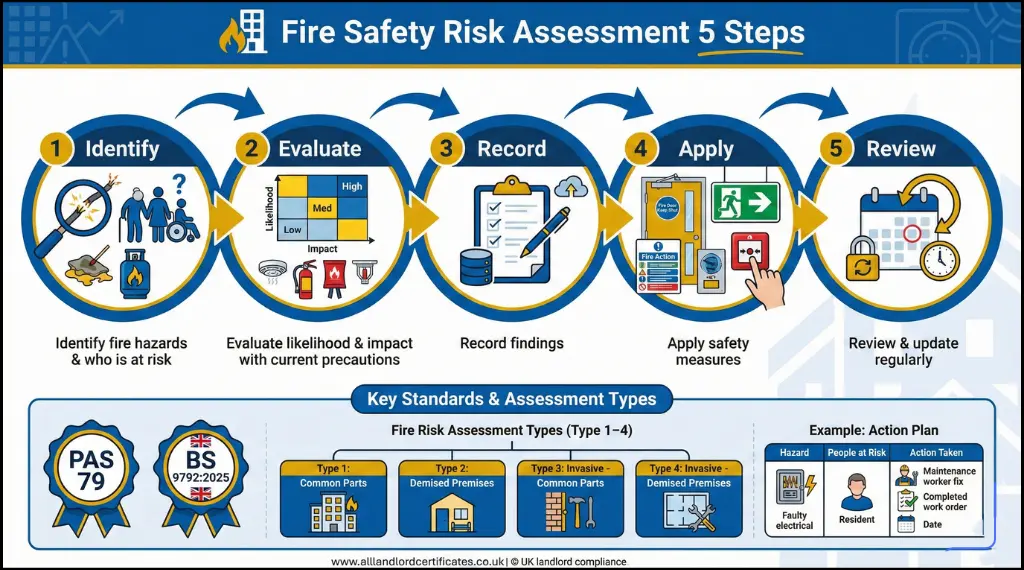
Let’s do a fire safety risk assessment in 5 steps. First, spot fire hazards and who is at risk. Next, check the likelihood and impact of fire with current precautions. Then, record findings and apply safety measures. Finally, review and update the assessment to keep everyone safe.
Fire Risk Assessment Checklist for Compliance
Following PAS 79 and BS 9792:2025 Standards
Fire safety for landlords covers the legal and practical responsibilities of building managers and landlords. It applies to all business owners across the UK. Fire safety management is guided by recognized standards such as PAS 79 and BS 9792:2025.
PAS 79 – Fire Risk Assessment Guidance
PAS 79 provides a clear process for carrying out fire risk assessments. It gives structured forms and templates to identify fire hazards, evaluate risks, and decide on control measures. PAS 79 makes fire risk assessments easy to do and legally safe. Here’s why it matters:
It gives you a clear structure so nothing gets missed. It provides templates and checklists, making your fire risk assessment straightforward. It helps you document everything properly, which is useful if you ever need to show regulators, insurers, or auditors that you’ve taken safety seriously.
BS 9792:2025 – Electrical Fire Safety Guidance
BS 9792:2025 provides essential guidance for managing electrical fire hazards in non-domestic buildings. Electrical faults are a major cause of fires in the UK, and this standard sets out a structured approach to reduce those risks.
Key Points
Compliance with UK law: Supports adherence to the New housing-specific standard published 2025 and other health and safety requirements. Protection of life and property: Helps prevent fires caused by faulty wiring, overloaded circuits, or deteriorating electrical equipment. Structured risk management: Provides a clear method for assessing, controlling, and mitigating fire hazards from electrical systems. Evidence of due diligence: Accurate documentation of inspections, maintenance, and repairs demonstrates professional management of fire safety. Focus on critical areas: Prioritizes locations with high electrical demand, older installations, or heat-generating equipment, reducing potential risk.
Significance
Following BS 9792:2025 ensures buildings meet legal obligations and maintain fire safety standards recognized across the UK. It protects occupants, staff, visitors, and property from electrical fire hazards. Compliance demonstrates responsibility, accountability, and professional fire safety management to regulators, insurers, and stakeholders.
To get more information about electrical safety and obtain your certificate, visit Alllandlordcertificates.co.uk.
Fire Risk Assessment Example and Types
Fire risk assessments help identify hazards and ensure people in a building stay safe. Below, we give you a clear overview of the main types and an example:
Fire Risk Assessment Types Type 1: Basic, non-destructive, communal areas only Type 2: Communal areas + destructive testing Type 3: Whole building, non-destructive Type 4: Whole building + destructive testing (most detailed)
Fire Risk Assessment Example Hazards: Electrical equipment, paper storage, and kitchen appliances. People at risk: Staff, visitors, mobility-impaired persons. Issues found: Blocked escape route, faulty fire door, out-of-date extinguisher. Actions: Clear escape route, fix door, replace extinguisher, update alarms. Review: Annually or after major changes.
Who Is Responsible for Completing a Fire Risk Assessment?
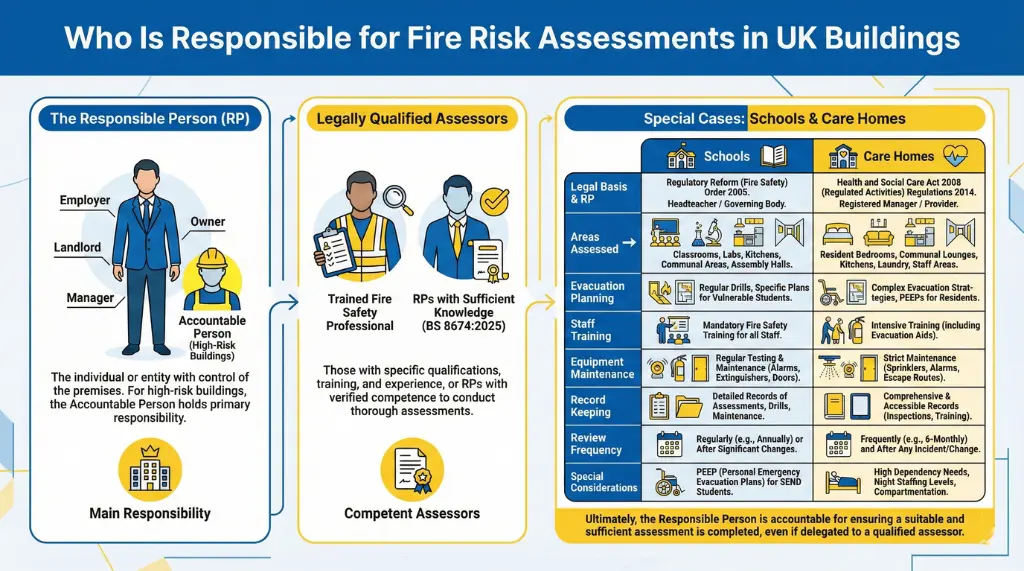
Did you know the Responsible Person (RP) must do a fire risk assessment? This can be the employer, owner, landlord, manager, or the Accountable Person for higher-risk buildings.
Who Can Do a Fire Risk Assessment Legally?
A fire risk assessment is a legal check to make sure a building meets fire safety standards. The person doing it must know fire safety and have the right training. This can be the owner, a responsible person, or a trained fire safety professional. BS 8674:2025 gives clear advice on keeping complex buildings safe from fire. Big or complex buildings need someone with more experience to make sure everything follows UK fire safety law.
Building Safety Risk Assessment Responsibilities Under New Legislation
As a landlord, looking after a building and the people inside is a big responsibility. New safety rules make it clear that owners and managers need to check for fire risks and other hazards. Take a look at that new legislation:
Fire Safety Act 2021: The law says fire risk assessments for buildings with several homes must check:
External walls, including cladding and balconies. Flat entrance doors. The inside structure of the building.
Building Safety Act 2022 for Higher-Risk Buildings: This applies to buildings that are taller than 18 meters or have 7 or more floors and contain 2 or more homes.
Key responsibilities include: The Principal Accountable Person carries out building safety risk assessments. Keep all safety information updated in the Golden Thread. Register the building with the Building Safety Regulator. Produce a Safety Case Report that shows how the building stays safe.
Fire Risk Assessment for Schools and Care Home Fire Risk Assessment Duties
Let’s discuss Fire Risk Assessment for Schools first, then we’ll move on to Care Homes. So, landlords, here’s what you need to know:
Are Fire Extinguishers, Fire Doors and Fire Alarms a Legal Requirement?
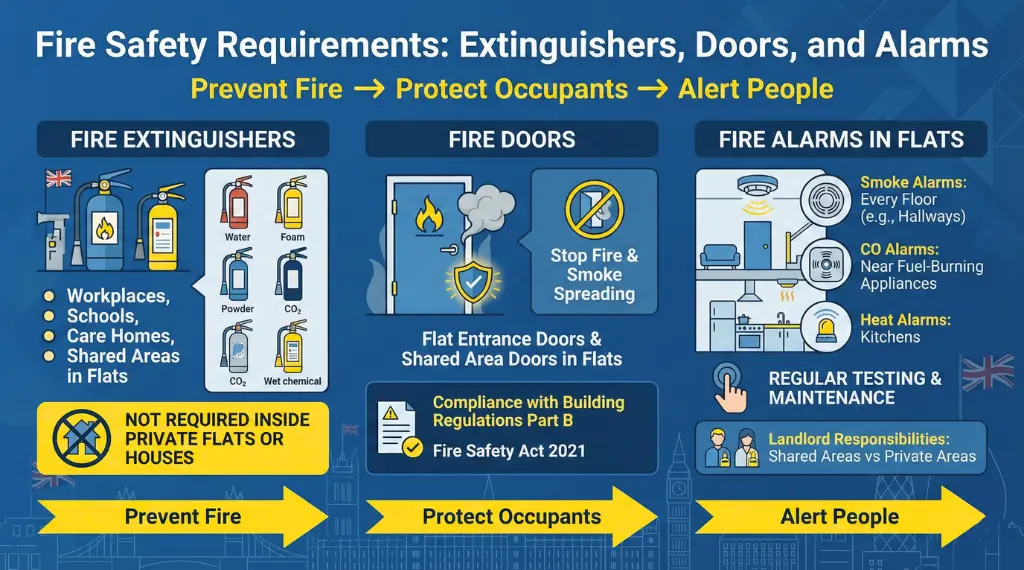
Yes, in buildings like schools, care homes, offices, and shops, fire extinguishers appear where a risk assessment finds a need. Fire doors stop fire and smoke from spreading, and fire alarms alert everyone quickly. These rules come from the Fire Safety Order 2005.
Are Fire Extinguishers a Legal Requirement in UK Buildings?
Yes, fire extinguishers are a legal requirement in UK buildings. A fire risk assessment shows if a building requires them. Workplaces, schools, care homes, and shared areas in flats have them to keep people safe. This rule comes from the Regulatory Reform (Fire Safety) Order 2005. Private flats and houses do not need them inside each home.
An event of a fire can happen anywhere. The risk of fire grows without care. Local fire and rescue teams help keep people safe. Fire prevention starts with clear rules. A competent fire risk assessor checks buildings for danger. Fire and rescue authority guides safety plans.
Are Fire Doors a Legal Requirement in Flats?
Yes, this one is most important in flats. Fire doors stop fire and smoke from spreading and give people more time to escape. Flat entrance doors and doors in shared areas like hallways and stairwells must meet fire safety standards. This comes from the Building Regulations Part B and the Fire Safety Act 2021.
Fire starting can spread fast. General fire knowledge saves lives. Fire safety legislation sets clear standards. Look for potential fire hazards. Fire safety in the workplace protects everyone.
What Are the Fire Alarms in Flats Regulations for Landlords?
That’s what every landlord ask about. As a landlord, you must fit smoke alarms on every floor with living space. These rules come from the Housing Act 2004 and related safety regulations.
The rules are: Put at least one smoke alarm on every floor of the flat. Make sure all alarms work properly when a tenant moves in. Fix alarms quickly if a tenant reports them broken. If the flat has a boiler, gas heater, or any fuel-burning appliance, put a carbon monoxide alarm in that room. Add extra alarms in living rooms or hallways for better safety. Use a heat alarm in the kitchen to avoid false smoke alarms. Check alarms regularly to make sure they are working. In buildings with shared areas, your responsibility is only the alarms inside your flat. Keep escape routes and doors clear and safe.
Specialist Fire Risk Assessments: HMO, Care Homes, and London Properties
Keep your properties safe and meet legal requirements with specialist fire risk assessments. We provide detailed reports for HMOs, care homes, and London properties to identify hazards, reduce risks, and ensure compliance with local regulations.
Fire Risk Assessment for HMO Properties: Enhanced Requirements
Let’s explore fire risk assessments for HMO’s. These buildings have more people living under one roof, that’s why safety rules are stricter to safe people and properties. Your assessments must follow the Regulatory Reform (Fire Safety) Order 2005, the Housing Act 2004 (HMO Licensing), and BS 5839 Part 1 for fire detection and alarm systems.
The requirements are: Fire alarms and smoke detectors in every bedroom and common area. Clear, well-lit escape routes and emergency signage. Regular checks on electrical systems and cooking appliances. Fire doors that close properly and prevent smoke spread.
Fire Risk Assessment in London: Local Authority Expectations
Fire Risk Assessment in London has extra rules for homes and businesses. London councils check buildings follow fire safety laws and Building Regulations 2010, Approved Document B. The rules are:
Fire risk assessments need to be submitted to local councils for approval. High-rise buildings require extra fire protection measures. Emergency lighting and fire drills are mandatory for residents and staff. Fire safety checks are carried out regularly by the local authority.
Care Home Fire Risk Assessment and High-Risk Premises
According to the Health and Social Care Act 2008, care homes and high-risk premises have vulnerable people, making fire safety extra important. Staff need clear instructions, and residents must know escape plans.
Fire alarm systems with sounders suitable for residents. Staff trained in evacuation procedures. Safe storage for oxygen or other medical gases. Fire doors and compartmentation to prevent fire spread.
When Should You Review a Risk Assessment?
A risk assessment gets a review when the building, occupants, how the space is used, or the landlord changes. It also gets a check after any fire incident to make sure safety stays strong.
Why Are Risk Assessments Important for Ongoing Compliance?
Risk assessments help you spot dangers before they become accidents. Review your risk assessment much. General fire precautions reduce danger. Reduce the risk of fire with small steps. Minimize the risk by staying alert. They make sure buildings follow fire safety laws all the time, not once.
Keep residents, staff, and visitors safe. Meet UK fire safety regulations without surprises. Identify problems early, like faulty alarms or blocked escape routes. Show authorities that safety is taken seriously.
What Is the Purpose of a Risk Assessment Review?
A risk assessment review makes sure safety measures still work, and nothing gets missed. It checks that the building, staff, and residents stay protected as things change.
Spot new hazards or risks. Update safety plans and escape routes. Ensure fire alarms, extinguishers, and doors work properly. Keep up with UK fire safety regulations.
Case Study
Harper Stone Properties Fire Case and Residential Fire Safety Impact
The fire in a shared stairwell of a four‑storey apartment block on Green Lanes, Palmers Green, North London in 2016 trapped residents and highlighted serious fire safety failings. Inspectors found that the management company had not carried out a proper fire risk assessment, putting people at risk.
Key lessons and safety impacts include: Fire doors must be properly installed and self-closing. Emergency lighting and clear escape routes are essential. Windows near stairwells must be fire-resistant to prevent smoke and fire spread. Proper fire risk assessments must be done and regularly reviewed. Fines and legal action can follow for non-compliance (Harper Stone Properties Ltd was fined £20,000 and ordered to pay £10,000 costs).
This case shows why fire risk assessments are crucial for protecting residents and staying compliant with UK fire safety rules.
Source: London Fire Brigade News – Property Company Fined for Fire Safety Breaches
Eurolets (UK) Limited Fire Safety Case in Islington
The fire-safety inspection of a five‑storey block on Danbury Street, Islington, North London in 2021 revealed serious hazards that put residents at risk. Inspectors found that Eurolets (UK) Limited had not carried out a proper fire risk assessment.
Key lessons and safety impacts include: Fire doors must be properly installed and self-closing. Escape routes must stay clear and unobstructed. Emergency lighting and fire signage are essential. Burnable materials not stored near exits. Regular fire risk assessments must be conducted and updated. Fines and legal action can follow for non-compliance (Eurolets (UK) Limited was fined £60,000 plus costs, totaling £80,170).
This case shows why fire risk assessments are essential for protecting residents and staying compliant with UK fire safety rules.
Source: London Fire Brigade News – Property Management Company Fined for Fire Safety Failings
Wrap up
Let’s bring everything together. Fire risk assessment requirements help you keep people safe and your property following UK rules. Checking your fire risk assessment keeps your property safe and ready for any changes.
Fire safety comes down to planning and paying attention. Keeping your fire risk assessments up to date gives peace of mind and makes sure your property meets UK law. For guidance, certificates, and practical tools, visit Alllandlordcertificates.co.uk and take the right steps for fire safety today.