Do you think your building stays safe from fire right now? Most of the landlord’s answer is no. That’s because they don’t know why fire risk assessments are required or how they protect people and property. This guide to fire risk assessment explains why these checks are needed in the UK and how they keep buildings safe.
Before we discuss this, let me show you a real incident that shows why this matters. At Hillcroft Residential Care Home in South Wales, inspectors find blocked escape routes, missing alarms, and faulty fire doors. These issues break fire safety rules, and the home faces a fine of £432,944.64.
After knowing this incident, you now understand how important fire risk assessments are for every building. Let’s explore together more about that.
What is a Fire Risk Assessment and Why is it Essential?
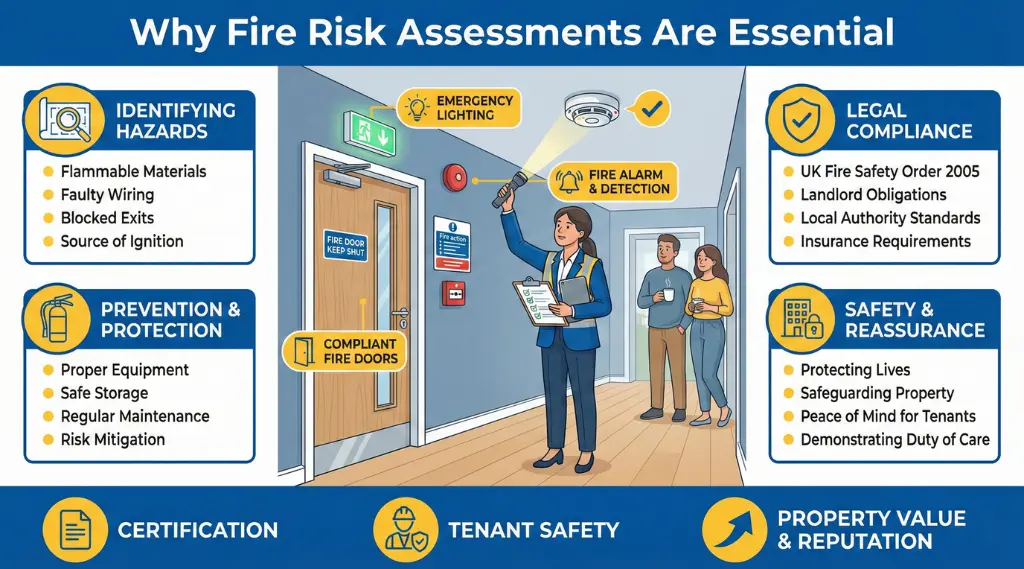
Let’s start with the basics. A fire risk assessment is a careful check of a building to spot fire hazards. It is essential because it keeps people safe, protects property, and ensures the building meets UK fire safety rules.
Understanding Fire Risk Assessment Fundamentals
Every building, from homes to offices, needs to follow proper fire risk assessment guidelines. A strong fire risk assessment looks at a few key things:
 Identify potential fire hazards, like flammable materials or faulty wiring. Check who can be at risk, such as residents, visitors, or staff. Decide on control measures to reduce or remove risks. Keep clear records and make an action plan. Update the assessment when changes happen in the building.
Why Are Risk Assessments Important for Your Property?
It’s a very common question landlords ask. It’s important because risk assessments keep people and buildings safe. Using clear fire risk assessment guides helps you find fire hazards, plan safe escape routes, and protect everyone in the building.
Here is why they matter: People can leave safely if a fire starts. Hazards get spotted and fixed before they cause damage. Buildings follow UK fire safety rules. Residents, tenants, and staff feel safe and confident. Managing fire safety becomes simple and clear.
Key Benefits of Regular Fire Safety Evaluations
To save people and property, regular fire safety checks are necessary. As a landlord, you can use trusted fire safety risk assessment guides to make it easier to see what works well and what needs fixing. Here are the key benefits:
Spot hazards before they cause harm. Keep escape routes clear and emergency systems working. Make sure buildings follow UK fire safety rules. Protect people and property from fire damage. Give everyone in the building confidence and peace of mind.
Is a Fire Risk Assessment a Legal Requirement in the UK?
Fire Risk Assessment Requirements are a legal duty for many buildings in the UK. These rules make sure landlords, property managers, and building owners keep people and property safe from fire.
Fire Risk Assessment Regulatory Reform Order 2005 Explained
The Regulatory Reform (Fire Safety) Order 2005 is the main law for fire safety in non-domestic buildings in England and Wales. It starts on 1 October 2006 and brings together over 70 older fire safety laws, including the Fire Precautions Act 1971. This law gives the “responsible person” the duty to take fire precautions that keep people safe. Key principles are:
Responsible Person (Articles 3–5): The employer, owner, landlord, or occupier who has a legal duty to ensure fire safety in the premises.
Fire Risk Assessment (Article 9): Must identify hazards, assess who is at risk, implement measures to reduce risk, record findings (if ≥5 employees), and review regularly.
General Fire Precautions (Articles 8 & 11): Include fire detection and warning systems, emergency routes and exits, firefighting equipment, training of staff, maintenance of safety systems, and planning for emergencies.
Protection of People (Article 14): Ensures safety for employees, visitors, contractors, and the public legally on the premises.
Enforcement and Compliance (Articles 28–31): Fire and Rescue Authorities can inspect, serve enforcement notices, prosecute for non-compliance, and require remedial action.
Record-Keeping (Article 9(3)): Written fire risk assessments are required if there are five or more employees, with documentation of findings and actions.
Maintenance and Testing (Article 17): Fire safety equipment, alarms, and escape routes must be properly maintained, tested, and recorded.
Proactive Risk Management: Focus on prevention and reduction of risk, rather than just following prescriptive rules.
Regular Review (Article 17 & 9(2)): Reassess risks when there are structural changes, new processes, or changes in occupancy.
Cooperation and Coordination (Articles 7 & 19): Where multiple responsible persons or employers exist, they must coordinate fire safety arrangements.
Special Considerations (Articles 12 & 14): Ensure vulnerable people (children, elderly, disabled) are adequately protected in evacuation planning.
Building Safety Act Fire Risk Assessment Requirements
Let’s talk about the Building Safety Act 2022. It keeps tall and complex buildings safer from fire. Fire risk assessment is a key part of these rules. Following proper fire risk assessment guidance helps make this process simple and effective. The key requirements are:
Full record of fire risk assessment: Section 156 says the responsible person must keep a written record of the fire risk assessment, including all findings. Also, fines can reach up to £5,000 for failing to keep records.
Record fire safety arrangements: Write down how fire safety works, like alarms, extinguishers, exits, and who is responsible.
Record identity of assessor(s): Note the name of anyone or any company carrying out the assessment.
Keep and share contact information: Store and share contact details of responsible persons, especially in shared buildings.
Cooperate with other responsible persons: Share fire safety information and work together if more than one person is responsible.
Pass on fire safety information when responsibility changes: Give the new responsible person all risk assessments and safety arrangements.
Inform residents in multi-occupancy buildings: Make sure occupants understand fire risks and the safety measures in place.
Fire Safety Regulations 2018 and Your Compliance Obligations
The Fire Safety Regulations 2018 set out legal requirements for fire safety in non-domestic premises, workplaces, and certain multi-occupancy buildings. The aim is to protect life, prevent injury, and minimize property damage due to fire. Key points are:
Conduct Risk Assessments – Identify fire hazards, evaluate risks, and document the findings to ensure your premises are safe.
Implement Fire Safety Measures – Install and maintain fire detection, alarms, emergency lighting, and fire-fighting equipment suitable for your premises.
Ensure Safe Evacuation – Keep emergency routes and exits clear, well-lit, and properly marked, and establish clear evacuation procedures.
Train and Inform Staff – Provide fire safety training, including evacuation drills and proper use of fire-fighting equipment, and communicate your fire safety policy.
Maintain Records & Review – Keep records of risk assessments, training, inspections, and equipment maintenance, and regularly review procedures to stay compliant.
Fire Risk Assessment Standards: PAS 79 and BS 9792:2025
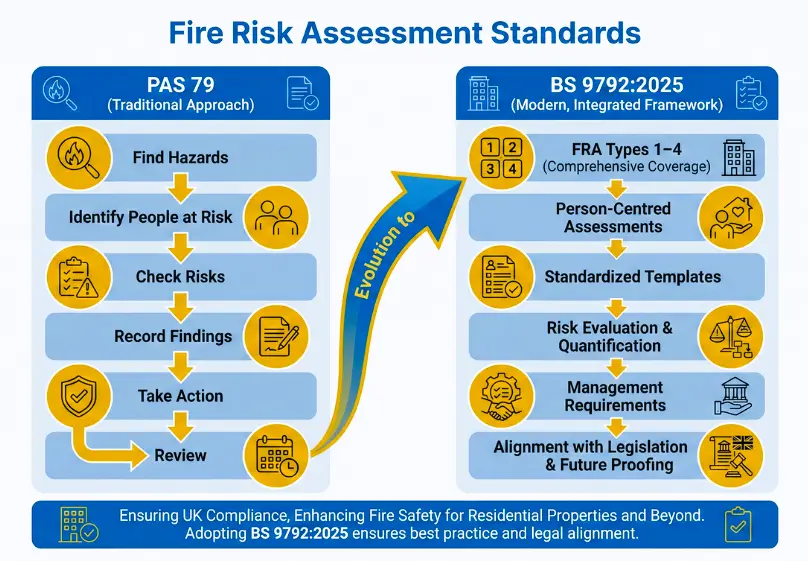
These are the new UK benchmarks for housing fire risk assessments. PAS 79 gives a clean structure for checking fire risks, and BS 9792:2025 brings new points that keep each check steady and consistent. If you look for a simple start, a guide to fire risk assessment helps you see how both standards link together.
What is PAS 79 and How Does It Apply?
PAS 79 is a Publicly Available Specification developed by the British Standards Institution (BSI) that provides guidance on the fire risk assessment process in buildings. PAS 79 is not a law, but a practical guide for checking fire safety in buildings. It helps organizations follow legal rules and manage fire risks in an organized way. It helps fire safety professionals and building owners conduct fire risk assessments in a structured way. Let’s break down how to apply PAS 79:
Find fire hazards Things that can start a fire, like electrical equipment, cooking appliances, or flammable materials.
Identify people at risk Staff, visitors, children, older people, or anyone who might have trouble moving quickly.
Check the risk How likely a fire can start and how much damage it can cause. Make sure alarms, fire doors, and escape routes work properly.
Record findings Use a simple format to list hazards, risks, and actions needed. Keep a clear record to review later and show inspectors or others.
Take action and review Fix problems and keep fire safety equipment ready. Review the plan if anything in the building changes.
BS 9792:2025 New Standards and Updates
BS 9792:2025 is a “Code of Practice” for fire risk assessments (FRAs) in housing (residential) settings. It was published by the British Standards Institution (BSI) and came into effect on 31 August 2025. The standard replaces PAS 79‑2:2020 and provides a formal framework for assessing and managing fire risks in residential buildings. Let’s explore this:
Formal British Standard status Replaces PAS 79-2:2020 with an official British Standard. Strengthens legal and professional recognition.
Scope focused on residential buildings Applies to HMOs, apartment blocks, sheltered housing, student accommodation, and shared-access areas. Excludes single private houses, short-term lets, care homes, and non-residential properties.
Reorganized content and clear structure Improves navigation and understanding. Updates clauses and annexes for clarity.
Defined FRA Types (1 to 4) Type 1: Common areas, non-intrusive inspection. Type 2: Common areas, intrusive inspection. Type 3: Common areas plus sample dwellings, non-intrusive. Type 4: Common areas plus sample dwellings, intrusive inspection, full evaluation.
Standardized documentation and templates Annex A provides a reporting format for the consistent recording of FRA results.
Person-Centred Fire Risk Assessments (PCFRA) Evaluates risks based on occupant characteristics such as mobility, sensory, cognitive, or health factors. Annex E provides a PCFRA template for integration in assessments.
Risk evaluation method Assesses hazards, protective measures, and occupant vulnerability with building-specific focus. Moves beyond generic checklist scoring.
Fire-safety management requirements Includes policies, procedures, training, action plans, record-keeping, and scheduled reviews.
Alignment with legislation and standards Consistent with the Fire Safety Act 2021 and Fire Safety (England) Regulations 2022. Works together with PAS 9980 (external wall risk appraisal) and BS 8674 (assessor competence).
Tailored assessment depth Selection of the FRA type matches building complexity and risk profile. Supports practical measures for risk reduction rather than uniform solutions.
The 5 Steps of a Fire Risk Assessment Process
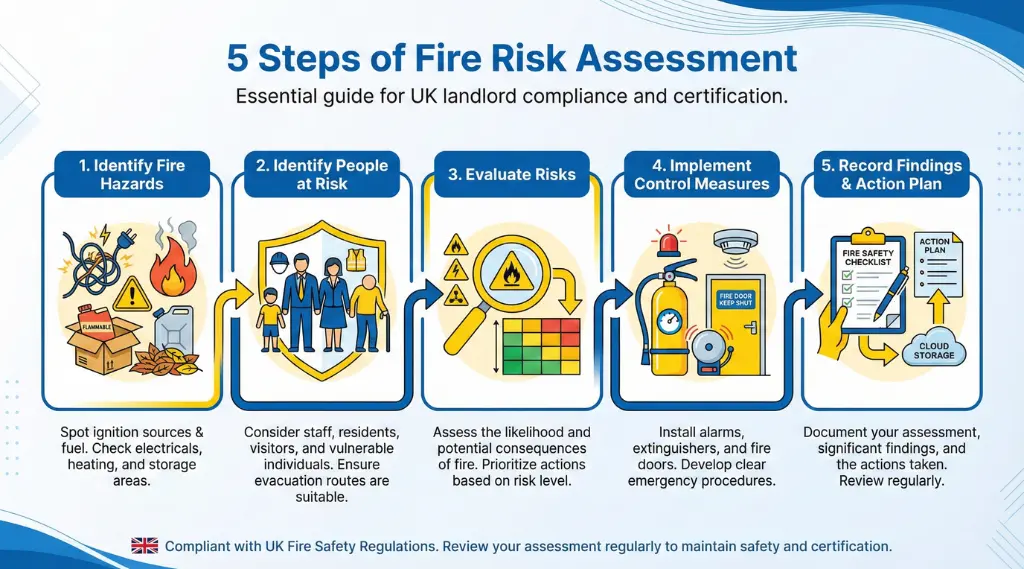
5 steps of a fire risk assessment help identify and manage fire hazards in any workplace. They include identifying fire hazards, identifying people at risk, evaluating, removing, or reducing risks, recording findings, and implementing measures, as well as regularly reviewing and updating to ensure safety.
Identifying Fire Hazards and People at Risk
The first step is to look carefully at the space and notice anything that can catch fire. Check electrical tools, open flames, and materials that burn quickly. At the same time, pay attention to people who are near these hazards. This can include staff, visitors, or anyone moving around the building. Knowing what is risky and who is at risk makes the next steps easier.
Evaluating Risks and Implementing Control Measures
Next, we think about how serious each hazard can be. Some things can cause big problems quickly, and some are smaller risks. Then, take action to make the area safer. This can mean putting equipment in safe spots, keeping materials away from heat, and making sure alarms and fire safety items are ready to use. Doing this keeps the place safer for everyone.
Recording Findings and Creating an Action Plan
Writing down what you find is very important. Note every hazard, the people at risk, and the steps to reduce danger. Then, make a simple plan that explains what needs to be done, who does it, and when it happens. This plan makes it easy to follow and keeps everyone on the same page.
Fire Risk Assessment Types: Residential vs Commercial Properties
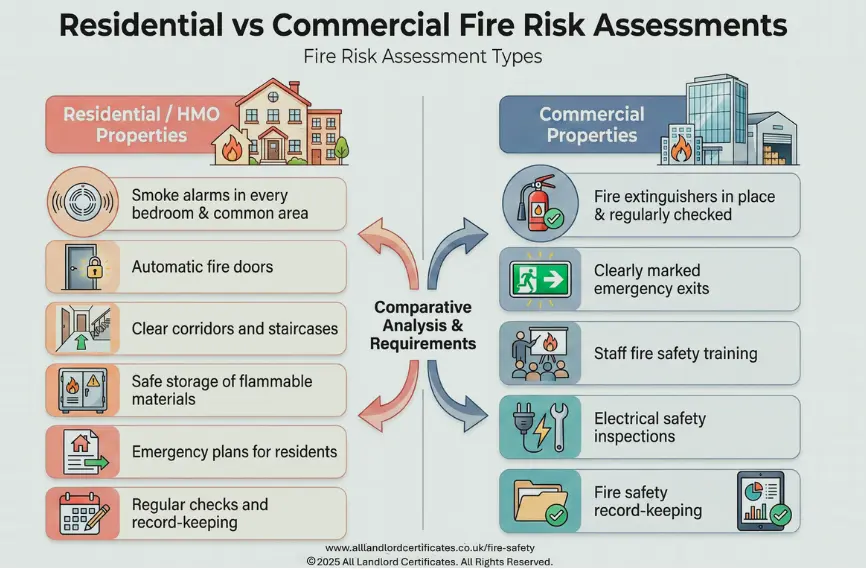
Fire risk assessment types change depending on the environment. Homes and commercial buildings face different dangers and need different safety steps. Doing the right type of assessment keeps people safe and protects property.
Fire Risk Assessment for HMO Properties
Fire safety for landlords means protecting tenants and keeping the property safe. As a landlord, you must carry out fire risk assessments according to the Housing Act 2004. They also need to follow HMO licensing rules to keep properties safe. Houses in Multiple Occupation (HMO) have extra rules because more people live under one roof. Let’s go over key steps: Fit smoke alarms in every bedroom and common area. Install fire doors that close automatically. Keep corridors and staircases clear of obstacles. Keep fire risk assessment records for inspection.
Fire Risk Assessment Residential Buildings Requirements
If you live in or manage a residential building, keeping everyone safe from fire is important.
Here’s what you need to do: Smoke alarms and detectors: Make sure they are installed and working properly. Clear escape routes: Keep all exits free from obstacles and easy to use. Flammable materials: Identify them and store them safely. Emergency plans: Create simple procedures for residents to follow if a fire happens. Regular checks: Inspect alarms, exits, and safety equipment to make sure everything works.
The findings of your fire risk check shape how a fire risk assessment is carried out across each premises to identify what needs attention. Support from the rescue service helps a block of flats stay steady and ready for strong health and safety.
Commercial Fire Risk Assessment Standards
If you run a business or manage a commercial building, fire safety is a top priority.
Here’s what needs attention: Make sure fire extinguishers are in place, easy to reach, and checked regularly. Keep all emergency exits clearly marked and free from obstacles. Train staff on what to do if a fire happens and how to use safety equipment. Check electrical equipment and wiring to reduce the chance of fire. Keep records of all fire safety checks and risk assessments.
In the event of a fire, a team uses risk assessment regularly to support simple fire safety precautions and to review your fire plan with care. Clear steps help reduce the risk of fire, and a risk assessment template keeps each note easy to follow. Buildings aim to comply with fire rules and also comply with fire safety duties, guided by a competent fire risk assessor who checks the likelihood of a fire.
Essential Components: Fire Risk Assessment Checklist
A fire risk assessment checklist shows you all the important safety points in a building. You can check smoke detectors, fire alarms, fire doors, extinguishers, emergency lighting, and escape routes. This makes a clear and simple guide to fire risk assessment that keeps everyone safe.
Fire Extinguisher Risk Assessment Procedures
A fire extinguisher risk assessment has five clear steps. First, spot hazards like heat, fuel, and oxygen that can cause a fire. Second, identify people at risk. This includes anyone inside the building. Third, reduce risks by placing the right extinguishers, keeping alarms working, and keeping escape routes clear. Fourth, write down findings, create an emergency plan, and train people on what to do in a fire. Fifth, review the assessment regularly to make sure everything stays safe and ready.
These steps make sure extinguishers match the fire types in the building, stay easy to reach, and help people use them safely. It protects everyone and keeps the building secure.
Fire Door Risk Assessments and Compliance
Fire doors play a big role in keeping people safe. They stop fire and smoke from spreading and give everyone more time to get out. A fire door risk assessment looks at everything, like the door itself, the frame, hinges, locks, closers, and seals. Check for any damage, gaps, or anything that reduces safety. Write down what you find and fix problems as soon as possible.
Compliance follows UK rules and standards. Key references include the Regulatory Reform (Fire Safety) Order 2005, Building Regulations Approved Document B, BS 9999, and BS 8214. To stay on top of things:
Make sure doors fit their frames correctly. Check that self-closing devices work properly. Confirm fire rating labels are correct and easy to see. Keep records of regular inspections and maintenance. Repair issues quickly after they appear.
Fire Alarm Assessment and Emergency Lighting Risk Assessment
Let’s talk about fire alarms and emergency lights. They keep everyone safe. Alarms warn people if a fire starts, and lights guide them out if it is dark or smoky. Checking them regularly makes sure they work when they matter most.
Fire Alarm Checks Make sure smoke and heat detectors stay clean and work properly. Walk through the building and check that alarms reach every room and corridor. Keep call points clear and easy to reach. Check panels and batteries to see that all signs and lights are correct.
Emergency Lighting Checks Make sure lights cover every escape route and exit. Check that exit signs are clear and easy to see. Test backup batteries to see if they stay on long enough. Keep all paths and corridors free from obstacles.
How Much Does a Fire Risk Assessment Cost?
Let’s talk about fire risk assessment costs, which are very important. Prices depend on the size, type, and complexity of the property. Bigger or more complex buildings cost more to assess.
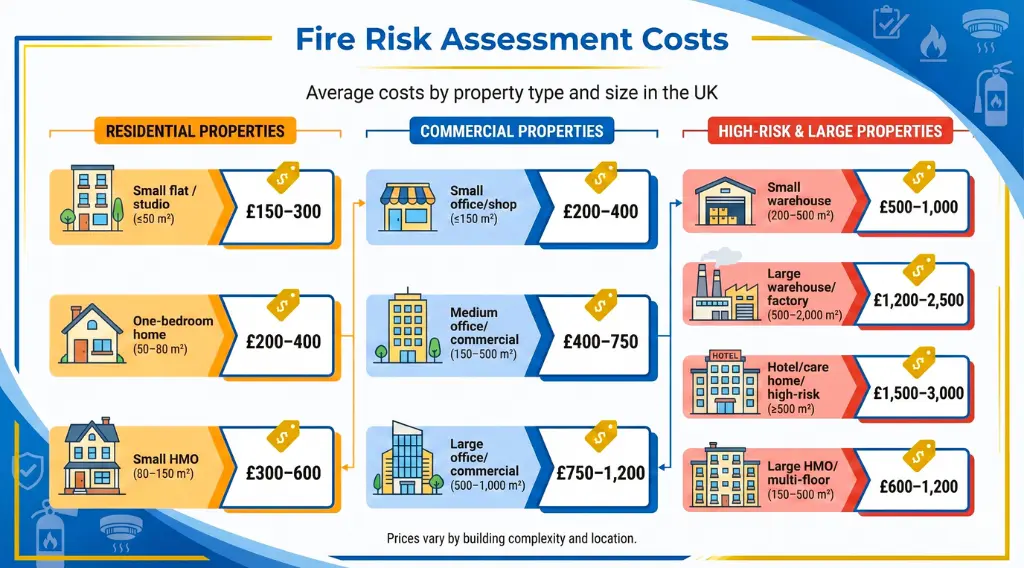
Factors Affecting Fire Risk Assessment Pricing
When it comes to fire risk assessments, the price can change depending on a few things. Some buildings need more checks or take more time, and that affects the cost. Here are the main factors:
Size of the building Type of building Layout and complexity Number of fire doors and safety systems Level of report detail Location Assessor experience
By completing a fire risk assessment, each local fire point gets simple fire safety advice shaped by fire safety legislation. A plan for effective fire prevention sits beside clear fire action steps that match fire regulations and keep the space calm and safe for all.
Average Costs by Property Type and Size
Many landlords ask us about the cost of a fire risk assessment. But the prices change across England, London, Wales, and Northern Ireland. The size, type, and complexity of the property affect the price. Here is a clear view of costs for different buildings:
Value of Professional Assessment vs DIY
Many landlords wonder if they can do a fire risk assessment themselves. For very small, simple properties, a DIY checklist gives a basic idea of risks. But Professional assessments provide more detail and clear guidance. Let’s explore it:
Professional Assessment Checks alarms, fire doors, emergency lighting, and escape routes. Produces a legal report that meets UK regulations. Finds hidden hazards that DIY checks miss. Keeps landlords legally compliant and tenants safe. Reduces risks in larger or complex properties like HMOs, offices, or hotels. Gives advice on improvements and prioritizes safety.
DIY Assessment Low cost and quick for small properties. Gives a basic view of fire risks. Allows checking at any time without scheduling. Highlights obvious hazards like blocked exits or faulty smoke detectors. Works for simple single-floor flats or small homes. Does not provide legal compliance or professional guidance.
How Often Should a Fire Risk Assessment Be Reviewed?
Let’s talk about how often should a fire risk assessment be reviewed. Keeping fire risk assessments up to date keeps tenants safe and ensures compliance with UK rules.
Review Frequency for Different Property Types
Different buildings need different review schedules. Keeping a clear schedule ensures safety and shows compliance with the law.
For example: Small residential flats: simple review once a year. HMO properties: more frequent checks due to multiple occupants. Commercial buildings and offices: review after any major changes in layout or occupancy. High-risk properties: review immediately after changes that increase fire risk.
Teams conduct a fire risk assessment and create a thorough fire risk assessment that also tracks any new fire concern or existing fire issue. They carry out a fire risk check to prevent fire and follow notes from the fire and rescue service.
Choosing Fire Risk Assessment Companies London and Qualified Fire Risk Assessors
Fire risk assessment companies London, like All Landlord Certificates, provide expertise and help create a proper legal report. Finding the right professional matters. You can see a list of trusted providers that we have given you. We check alarms, emergency lighting, fire doors, and escape routes. Using qualified assessors keeps landlords safe from compliance issues and gives confidence in building safety.
Fire Risk Assessment in London: Local Regulations and Best Practices
Fire risk assessment in London follows the Regulatory Reform (Fire Safety) Order 2005, plus local guidance for buildings and HMOs. Fire safety rules can change depending on the area. Best practices include regular inspections, updating records, and addressing hazards immediately. Following local rules reduces risk and keeps tenants safe.
Case study
1. Crownpark Investments Fire Case and Residential Fire Safety Impact
In 2011, a pair of old houses converted into flats in London caught fire. The fire spread across several floors and trapped residents on the upper levels. Inspectors found major fire safety problems and discovered the building did not have a proper fire risk assessment in place.
Key lessons and safety impacts: Fire detection and alarm systems must be installed to warn residents in time. Flat entrance doors and communal doors need to be fire-resistant to protect escape routes. Fire risk assessments must be carried out and kept up to date. Fines and legal action follow if rules are ignored. The landlord and management company were fined £250,000 and had to pay £49,500 in costs.
This case shows how important fire risk assessments are for protecting residents and staying compliant with UK fire safety law under the Regulatory Reform (Fire Safety) Order 2005. Acting on assessment findings makes buildings safer and prevents serious accidents.
Source: London Fire Brigade – Record Fine for Landlord Over Fire Safety Failures
Our Work
One of our clients had 2 properties in SE London where fire doors did not meet safety standards. The engineers at All Landlord Certificates carried out detailed fire risk assessments and recommended self-closing fire‑rated doors and improved emergency lighting. After implementation, both buildings passed all inspections with no safety issues.
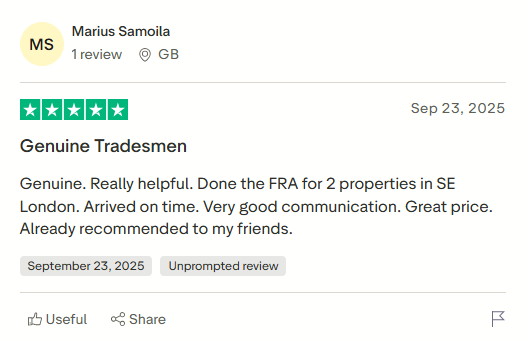
Source: Trustpilot
Wrap Up
Let’s wrap it up. Fire risk assessments are more than paperwork. They keep people safe, protect buildings, and follow UK law. Doing them right, with qualified assessors and clear action, helps landlords and residents feel secure. At All Landlord Certificates, we make it easy to stay on top of fire safety. Taking care of it today keeps emergencies far away tomorrow.